We're Lying to Workers When We Say the Minimum Wage is Too Low
We've turned wage policy into moral theater while productivity rots

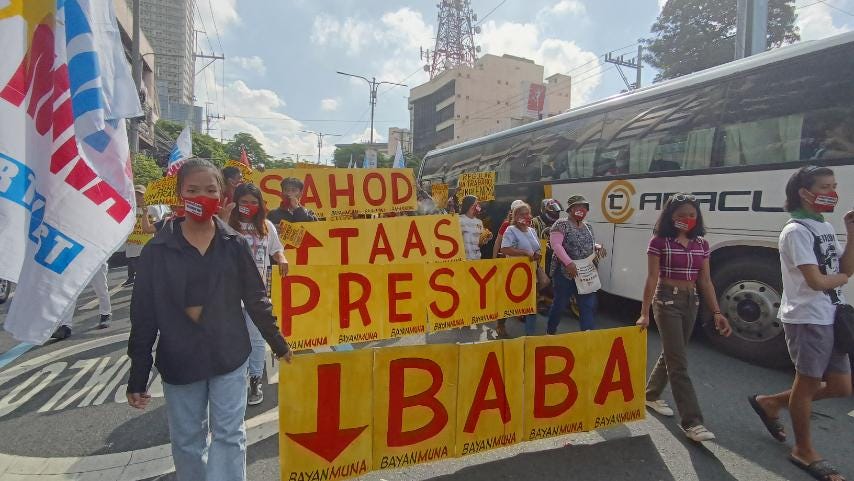
WE tell ourselves a comforting story about Philippine wages: workers are exploited, the minimum is too low, and raising it is both just and economically sound. Labor groups demand 750 pesos daily. Politicians campaign on wage hikes. Columnists frame resistance as corporate greed. The narrative is so entrenched that questioning it feels like siding with exploitation.
But what if the story is backwards? What if Philippine minimum wages are not too low, but actually among the highest in Southeast Asia when measured against what workers can produce? And what if our obsession with legislating higher floors is precisely what traps millions in informality, unemployment, and the very poverty we claim to be fighting?
The evidence is uncomfortable, but it is overwhelming. And until we stop lying to ourselves about it, we will keep prescribing exactly the wrong medicine.
The metric that matters is the one we refuse to discuss
When Labor Secretary Bienvenido Laguesma stated in 2025 that Philippine minimum wages are already “among the highest in Southeast Asia,” he was not engaged in union-busting propaganda. He was citing DOLE’s own comparative tables showing that our wage floors—particularly in Metro Manila, currently at 610 pesos or roughly 10.70 USD daily—exceed those in Vietnam, Cambodia, Myanmar, Laos, and often match or surpass Indonesia’s rates outside Jakarta.
But nominal comparisons miss the crucial question: high relative to what?
A minimum wage is only meaningful when measured against productivity—what a worker can actually produce per hour. This is not an abstraction. It determines whether hiring someone at the legal wage makes economic sense, or whether that worker prices themselves out of formal employment entirely.
Here the Philippine position becomes indefensible.
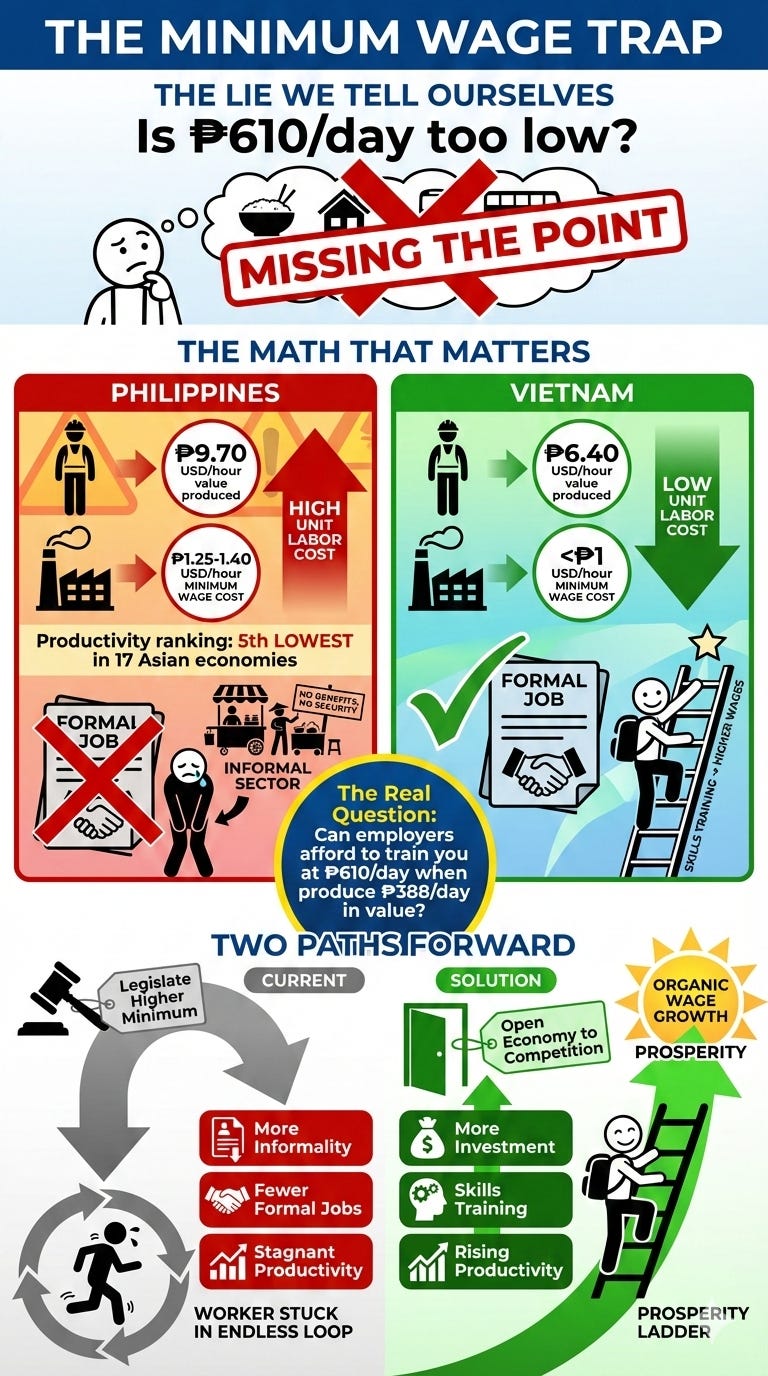
World Bank data for 2023 show Philippine labor productivity at 23,519 USD per worker annually—placing us fifth-lowest among 17 East and Southeast Asian economies with available data. We sit below the East Asia and Pacific average of 43,715 USD and the global average of 47,919 USD. Asian Productivity Organization (APO) figures for 2020 reveal that the average Philippine worker produces about 9.70 USD per hour in value added—higher than Vietnam’s 6.40 USD, but below Indonesia’s 12 USD, and laughably distant from advanced Asian economies.
Now do the math. If the Metro Manila minimum wage translates to roughly 1.25–1.40 USD per hour in direct wage costs, and the average worker produces 9.70 USD per hour, the unit labor cost—the wage paid per unit of output—starts to look expensive. Not exploitative. Expensive.
Compare this with Vietnam, where productivity is lower at 6.40 USD per hour, but minimum wages in many regions fall below 1 USD per hour. The Vietnamese employer can hire at a lower cost relative to what that worker produces. The Philippine employer cannot. The result? Vietnamese formal employment expands. Philippine formal employment stagnates.
When was the last time you asked yourself why so many Filipinos can’t find formal work despite being willing to accept the minimum wage? Could it be that the wage floor we’ve set is simply higher than what millions of low-skilled workers can produce?
We’ve mistaken our good intentions for good policy
The typical response is moral indignation: “Are you saying workers should accept starvation wages?” No. What we are saying is that legislating a wage does not create the productivity to justify it. You cannot decree someone into being worth 610 pesos a day. You can only decree that if they are not worth 610 pesos to an employer, they will not be hired at all.
And that is exactly what happens.
Research across comparable economies consistently shows that binding minimum wages in low-productivity contexts produce three outcomes: elevated informality, spatial dualism, and stalled structural transformation. The Philippines exhibits all three.
First, informality. Business groups and labor leaders in Northern Mindanao have warned repeatedly that across-the-board wage increases of 100–300 pesos could trigger closures and layoffs, particularly among micro, small, and medium enterprises operating on thin margins. These are not idle threats. When firms cannot profitably employ workers at the mandated rate, they shift to informal arrangements, reduce hours, substitute capital for labor, or simply do not expand. The result is that Philippine workers face both a “high” minimum wage and difficulty securing full-time formal employment—a perverse combination where the law prices them out of the protections it claims to provide.
Second, regional and sectoral dualism. In high-productivity enclaves—export zones, large BPO centers—the minimum wage is often non-binding because competitive firms already pay above it. But in less developed regions and traditional sectors, the same wage floor becomes prohibitively expensive relative to local output. This is why minimum wage earners in provincial areas struggle to find steady work, while Metro Manila’s skilled workers earn multiples of the legal floor. The minimum wage does not raise the floor for everyone; it creates a two-tier economy where some workers are in and most are out.
Third, stalled transformation. A World Bank analysis of ASEAN productivity trends from 2005–2015 found that while global firms in digital and electronics manufacturing raised productivity by 76 percent, the Philippines, Indonesia, Malaysia, and Vietnam averaged only 31 percent growth. The Philippines underperformed even within this lagging group. Why? Because when unit labor costs at the bottom of the wage distribution are high relative to output, firms avoid low-skill formal employment. Workers remain trapped in subsistence agriculture and petty services instead of moving into higher-productivity manufacturing and formal services. The economy cannot absorb them.
Have you ever wondered why the Philippine economy seems perpetually stuck between too few good jobs and too many bad ones? This is not a mystery. It is wage policy running headlong into productivity reality.
Raising the floor does not raise the ceiling
The Philippine minimum wage can be simultaneously “high” relative to what firms can afford and “low” relative to what a family needs to survive. This is not a paradox. It is the predictable result of trying to solve a productivity problem with a wage law.
Labor advocates are correct that 610 pesos daily cannot sustain a family in Metro Manila. But the solution is not to mandate 750 pesos, or 850 pesos, or whatever figure sounds morally sufficient. Doing so simply raises the productivity threshold required for formal employment, pushing more workers into informality or unemployment.
The solution is to raise productivity itself—to create an economy where workers can produce enough value that employers willingly pay them more because it makes business sense, not because it is legally required.
And here we confront the real policy failure.
The economy we refuse to open is the trap we refuse to escape
Philippine productivity lags because our economy remains structurally closed, over-regulated, and hostile to the very investment and competition that would raise worker output. Foreign equity restrictions in retail, telecommunications, transport, and numerous service sectors limit competitive pressure and technology transfer. Barriers to entry protect incumbent firms from rivals that might force productivity improvements. Rigid labor regulations discourage firms from experimenting with training and upskilling programs because hiring and termination costs are prohibitively high.
The result is an economy where firms compete by keeping costs low rather than raising output. Workers remain low-skill because firms have little incentive to invest in training when they cannot flexibly adjust their workforce. Productivity stagnates. Wages stagnate. And politicians respond by legislating higher wage floors, which simply accelerate the cycle.
When was the last time a politician campaigned on making it easier to start a business, hire workers, and compete freely? Never, because it polls poorly. Wage hikes poll well. The fact that wage hikes without productivity growth destroy jobs is inconvenient, so we ignore it.
Consider the counterfactual. If the Philippines opened retail, telecommunications, and logistics to full foreign competition, what would happen? Competitive firms would enter with capital, technology, and training systems. To compete for workers, they would need to raise productivity. As workers became more productive, wages would rise organically, not because of legal mandates, but because firms that did not pay competitive wages would lose talent to rivals.
This is not speculative. It is what happened in Vietnam. Despite lower initial productivity, Vietnam attracted vastly more foreign direct investment by maintaining an open, competitive business environment. Firms entered, trained workers, raised productivity, and wages followed. Vietnamese formal employment expanded while Philippine formal employment stagnated.
The difference was not labor laws. It was whether the economy was open enough to let productivity rise.
What raising minimum wages actually accomplishes
A 2016 Willis Towers Watson report noted that Philippine labor costs were among the lowest in ASEAN for professional and middle-management roles, reflecting the country’s comparative advantage in low-cost, English-speaking labor. Yet this “competitive” average wage coexists with a high statutory minimum precisely because large portions of the workforce operate below the formal floor, in sectors and regions where enforcement is weak or nonexistent.
What does this tell us? That the minimum wage is largely irrelevant to workers who actually need it most. Those in the formal sector—already employed by firms productive enough to comply—see modest gains. Those in the informal sector see nothing, except fewer opportunities to transition into formality.
Raising the minimum wage, then, is not a pro-worker policy. It is a pro-employed-worker policy, and only marginally even then. It protects insiders at the expense of outsiders. It makes politicians look compassionate while doing nothing for the millions trapped in informality.
If you genuinely cared about low-wage workers, would you advocate for a policy that makes it harder for them to get hired? Because that is what high productivity-adjusted minimum wages do.
Productivity is not optional
The Philippine Energy Plan 2023–2050 sets a target of 35 percent renewables by 2030. We have four years. Meeting that target requires billions in investment, advanced technology, and a workforce capable of building, operating, and maintaining modern energy infrastructure.
None of that happens if firms cannot hire workers at wages that reflect current productivity while investing in training to raise future productivity. If every entry-level worker must be paid as if they are already productive, firms will not hire them. They will automate, offshore, or simply not expand.
This applies across sectors. Manufacturing, logistics, services—all require workers to start at lower productivity and improve over time. That improvement requires investment in training, technology, and management systems. But investment requires flexibility. And flexibility requires acknowledging that not all workers are equally productive on day one.
The Philippine wage system denies this reality. It pretends that legislating a wage creates the value to justify it. It does not. It never has. And every time we raise the minimum without raising productivity, we consign more workers to informality and unemployment.
Stop lying. Start building.
The real scandal is not that Philippine wages are low. It is that we have created an economic structure that prevents them from rising organically. We have trapped workers in low-productivity sectors, blocked the investment and competition that would raise output, and then blamed employers for not paying wages that the economy cannot sustain.
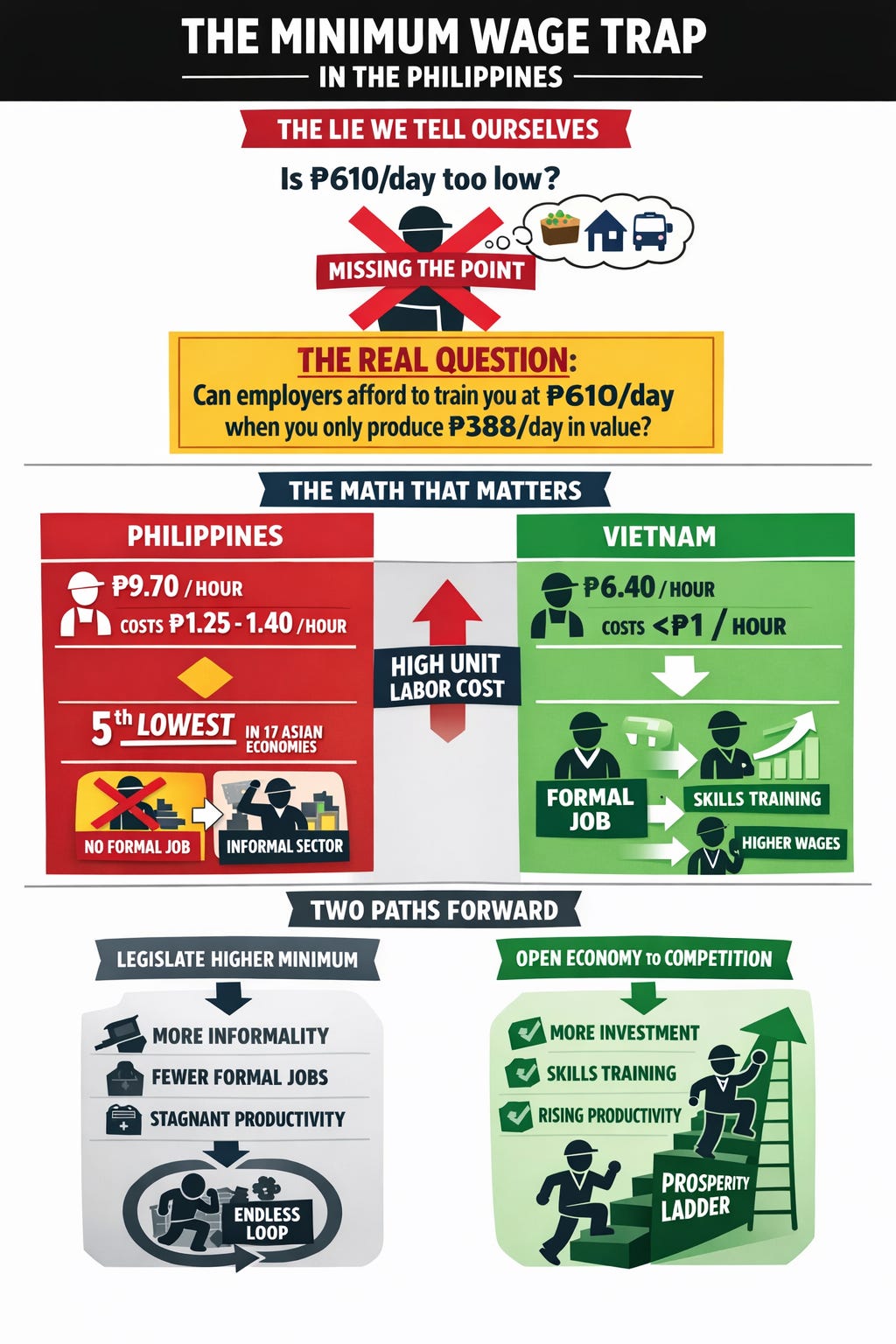
Labor advocates are right to demand better lives for workers. But they are wrong about the mechanism. The path to higher wages is not higher legal minimums. It is higher productivity. And the path to higher productivity is opening the economy to investment, competition, and the creative destruction that forces firms to innovate or fail.
What are you willing to give up to make that happen?
Are you willing to let foreign firms enter protected sectors? Are you willing to accept that some domestic firms will fail when they face real competition? Are you willing to let employers hire and train workers flexibly, even if that means some jobs are short-term?
If not, then stop pretending you want higher wages. What you want is the moral satisfaction of demanding them without bearing the cost of creating the conditions that make them possible.
The choice is clear. We can continue legislating higher wage floors and watching formal employment stagnate while informality grows. Or we can do the hard work of opening the economy, raising productivity, and letting wages rise because workers are actually worth more, not because a law says they should be.
One path feels good. The other works.
Which do you choose?