Democracy Hasn't Saved The Philippines—It's Killing It
The god of Democracy Failed the Philippines

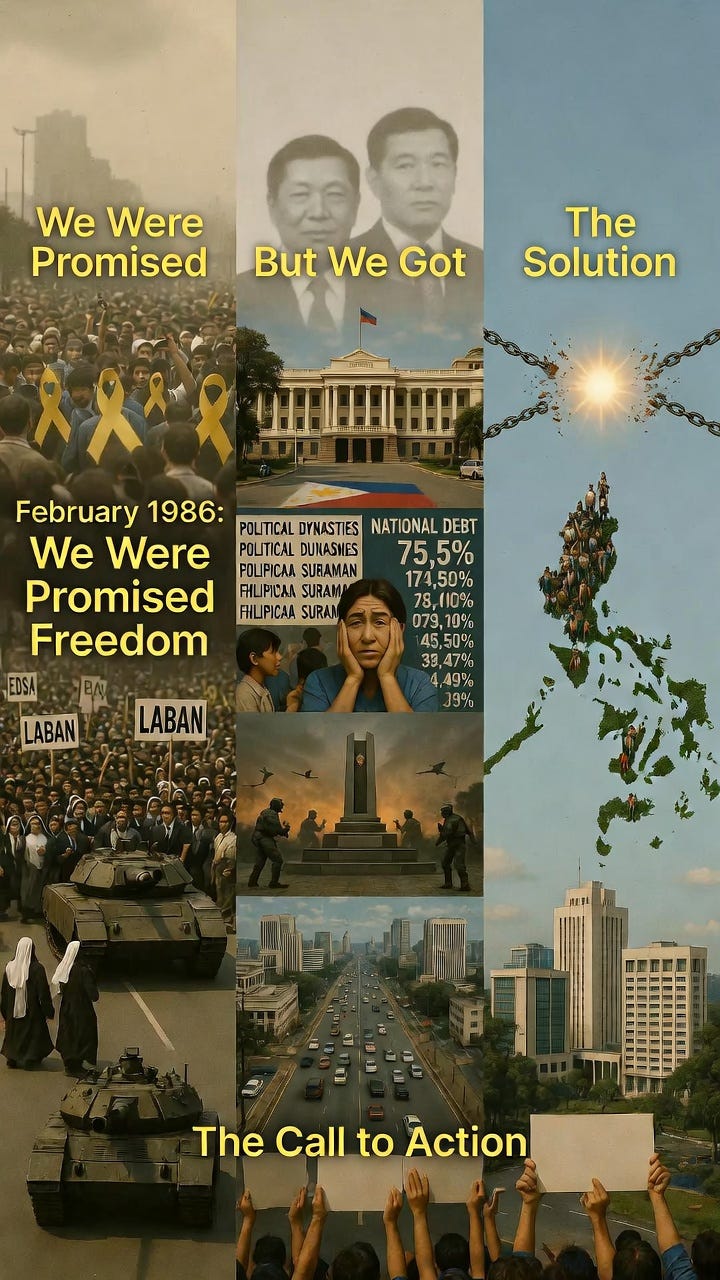
Forty years after EDSA, and we’re still pretending it worked.
We overthrew a dictator in 1986 with prayers and flowers, and what did we get? We got Cory Aquino promising a new dawn while her relatives positioned themselves for congressional seats. We got Ramos selling our power plants to his friends. We got Estrada’s midnight cabinet and jueteng money. We got Arroyo stealing an election on tape—”Hello Garci,” remember?—and facing zero consequences until she’d already looted what she wanted. We got Noynoy riding his parents’ corpses to Malacañang while his kaibigan in the Liberal Party played tong-pats with the DAP and the PDAF. We got Duterte turning our drug war into a killing field with our votes, our mandate, our democratic will.
And now? Now we’ve got the Marcoses back in Malacañang. The son of the dictator we overthrew is president. His sister is a senator. Their mother never saw the inside of a jail cell despite billions in stolen wealth.
Tell us again how democracy saved us. We’re listening.
We Treat Our Country Like a Rental Property
Here’s what the Austrian economist Hans-Hermann Hoppe understood that we refuse to accept: when you rent something, you trash it. When you own something, you protect it.
A king—whatever else you want to say about him—treats his kingdom like his property because it is his property. He’ll pass it to his children. He thinks long-term. He preserves. He builds. Not because he’s moral, but because he’s rational. You don’t burn down your own house.
But a politician in a democracy? He’s a renter. A temporary caretaker with a six-year lease at most. So what does he do? He strips the copper wiring. He sells the fixtures. He pockets everything that isn’t nailed down and half of what is. Because in six years, it’s someone else’s problem.
Look at our political dynasties and tell us this isn’t exactly what’s happening. The Aquinos didn’t build Hacienda Luisita—they inherited it and fought tooth and nail to keep farmers from getting what was legally theirs. The Marcoses didn’t develop Ilocos Norte—they turned it into a propaganda factory while siphoning billions into Swiss banks. The Ampatuans didn’t serve Maguindanao—they turned it into a private kingdom where they could massacre 58 people in broad daylight.
Every single one of them treated public office like a rental property. Strip it, sell it, move on.
Do we really think this is what liberation looks like?
Our Debt Is Democracy’s Receipt
Follow the money and you’ll see democracy’s footprints all over our corpse.
When Marcos fled in 1986, he left us with $28 billion in debt. Unconscionable. Criminal. We spent decades paying it off while our children went hungry. But here’s what we don’t want to admit: we didn’t stop. Every democratic government after Marcos kept borrowing. Aquino borrowed. Ramos borrowed. Estrada borrowed. Arroyo borrowed so much she made Marcos look conservative. Noynoy borrowed despite the growth statistics. Duterte borrowed despite the Build Build Build promises.
As of 2024, our national debt is over ₱15 trillion. That’s more than 60% of our GDP. That’s ₱130,000 for every Filipino man, woman, and child.
Why? Because democracy encourages it. Because politicians know they can spend today and let tomorrow’s taxpayers handle the bill. Because voters reward whoever gives them the cash handouts, the 4Ps transfers, the ayuda, the infrastructure projects with their names on plaques—never mind that our grandchildren will be paying for it.
Hoppe called this “high time preference”—the tendency to value now over later. Kings think in dynasties. Democrats think in election cycles.
We think in handouts and photo opportunities.
Is this really worth celebrating every February 25th?
We Wage War on Ourselves
Here’s another lie they sold us: democracies don’t go to war with each other. Democratic peace theory. Nobel Prize–winning stuff.
Except it’s complete nonsense when you’re waging war on your own people.
Since 1986—since our “democratic restoration”—we’ve killed more Filipinos in the name of democracy than Marcos killed during martial law. We’ve had the Mendiola Massacre (1987): farmers shot dead asking for land reform under Cory’s democratic government. We’ve had Hacienda Luisita (2004): workers mowed down by troops while Noynoy sat in Congress. We’ve had Mamasapano (2015): 44 SAF commandos abandoned to die in a botched operation while their president played video games. We’ve had Duterte’s drug war: 30,000 dead by conservative estimates, killed without trial, dumped in alleys with cardboard signs, all in the name of democratic mandate.
Don’t forget our endless insurgencies. The CPP-NPA has been fighting for over 50 years—longer than Marcos ruled, longer than any dictatorship could sustain itself. The Moro conflict dragged on for decades until we carved out the BARMM, essentially admitting that democratic Manila couldn’t govern Muslim Mindanao. And still the violence continues.
Why? Because democracy creates what Hoppe called “total war.” Not just soldier against soldier, but ideology against ideology, class against class, region against region. Democracy tells everyone they’re equal, then makes them fight over the scraps. It tells Mindanao they have a voice in Manila, then ignores them for decades until they pick up guns.
Under Marcos, we knew who the enemy was. Under democracy, we’ve become the enemy.
Which system actually killed more of us?
Our Bureaucracy Metastasized into a Tumor
Remember when government was supposed to be limited? When the 1987 Constitution promised to restrain power after Marcos’s excesses?
Look at us now. We have 24 Cabinet departments. Over 400 government-owned and -controlled corporations. Bureaus and agencies and offices that overlap and contradict and duplicate each other’s functions. DPWH builds roads. But so does MMDA. And sometimes LGUs. The Department of Agriculture has programs. But so does DAR. And DENR. And DTI. Nobody knows who’s responsible for what, which means nobody’s responsible for anything.
This is what Hoppe meant by the transition from limited to unlimited government. Democracy doesn’t constrain power—it spreads it like cancer. Because every constituency needs to be bought. Every voting bloc needs its agency. Every region needs its pork. Every representative needs something to bring home to show he’s “working.”
So we created the CDF. Then the PDAF. Then the DAP when PDAF got too scandalous. Then we’ll create something else when DAP becomes toxic. We’ll call it by different names—lump sum, special purpose funds, miscellaneous appropriations—but it’s all the same: unlimited government buying unlimited loyalty with our unlimited debt.
Under Marcos, we had one dictator to overthrow. Under democracy, we have thousands of little dictators, each one protected by votes, by connections, by the sacred rituals of electoral legitimacy.
How exactly is this better?
We Built a Welfare State That Breeds Dependence
Let’s talk about the 4Ps—the Pantawid Pamilyang Pilipino Program. Our politicians love to brag about it. “We’re helping the poor!” they say. “We’re investing in human capital!”
What we’re really doing is creating a permanent underclass of dependents who will vote for whoever keeps the checks coming.
Under the 4Ps, we give cash transfers to poor families if they keep kids in school and get health checkups. Sounds noble, right? Except now we have over 4 million household-beneficiaries. That’s roughly 20 million Filipinos—nearly 20% of our population—receiving government handouts. The program costs over ₱100 billion a year.
And what’s happened? Poverty rates haven’t meaningfully declined. We’re still at over 20% living below the poverty line. Because we’re not addressing why they’re poor—we’re just making poverty more comfortable. We’re paying them to stay poor.
Hoppe warned about this: redistribution doesn’t eliminate poverty, it institutionalizes it. It creates a voting bloc that depends on continued redistribution. And it punishes everyone else—the workers, the entrepreneurs, the savers—by taxing them to fund a system that rewards not working.
Before democracy, before the welfare state, Filipino families survived through bayanihan, through extended kinship networks, through mutual aid that didn’t require bureaucrats and budgets. Now? Now we’ve outsourced compassion to politicians who use it to buy votes.
We’ve traded self-reliance for dependency. We’ve traded dignity for dole-outs.
Was this what we fought for in EDSA?
Our Culture Is Rotting From Within
Here’s what nobody wants to say: we’re becoming a uglier, coarser, more broken society under democracy.
Look at our families. We can’t legally divorce in the Philippines—we’re one of the last countries on earth that can’t—but we have one of the highest rates of family separation and abandonment in Asia. OFW mothers leave their children for years. Fathers disappear. Annulment is only for the rich. The poor just move on to new partners, creating complicated half-sibling networks that fracture inheritance and obligation.
Look at our cities. Manila is one of the most densely populated cities on earth, with slums literally built on top of garbage dumps. We have children living in cemeteries. We have families of eight in 10-square-meter shanties. And every election, politicians promise housing. And every term, the slums grow.
Look at our youth. We have the highest rate of teen pregnancy in Southeast Asia. We have rising drug use despite—or because of—Duterte’s war. We have a generation raised on TikTok and online sabong and Facebook conspiracy theories, with no grasp of history, no sense of continuity, no connection to anything beyond the immediate.
Hoppe called this “decivilization”—the breakdown of the moral and cultural bonds that hold a society together. Democracy does this, he argued, because it treats everyone as equal regardless of merit, wisdom, or contribution. It elevates the mob. It punishes excellence. It rewards the loudest voice, not the best argument.
In the Philippines, we see this in our political discourse. We elected Erap despite his obvious incompetence because he was masa. We elected Duterte despite his vulgarity because he cursed like we curse. We elected Bongbong despite his father’s crimes because... well, because we forgot. Because under democracy, nothing matters except what feels good right now.
Our civilization isn’t being destroyed from outside. We’re voting for its destruction every three years.
Can we even recognize what we’ve become?
We Chained Ourselves to Manila
Here’s the cruelest joke of all: we call ourselves a democracy, but we’re really a centralized autocracy wearing democratic makeup.
Everything flows through Manila. Taxes collected in Davao go to Manila. Budget decisions for Cebu are made in Manila. Infrastructure priorities for Mindanao are determined in Manila. If you want anything—a permit, a license, a approval, a favor—you go to Manila or you send someone to Manila or you know someone in Manila.
The Bangsamoro conflict? That was Mindanao saying “We’re not like you, we don’t want Manila ruling us.” Fifty years of violence. Over 150,000 dead. And our democratic solution? We created BARMM—basically admitting that parliamentary democracy can’t work when you try to govern diverse peoples from a central capital.
The Visayas? Perpetually ignored unless there’s an election or a typhoon. Cebu generates enormous wealth and gets back a fraction in services. The provinces bleed young people to Manila because that’s where the jobs are, where the universities are, where the government is.
Hoppe’s solution was secession—the right of regions to break away from failing states. In the Philippines, we don’t even allow federalism, which is secession-lite. We’re terrified of devolving power because Manila’s political dynasties would lose their monopoly.
But here’s what we’re not admitting: the unitary system is already failing. Regions are already functionally autonomous in their dysfunction. What we have isn’t unity—it’s uniform stagnation.
How much longer can we pretend this is working?
The Parliamentary-Federal Solution We’re Too Scared to Try
So what do we do? Roll over and accept that democracy failed?
No. We do what every other successful country has done: we fix the structure.
We need federalism. Not because it’s perfect, but because it’s survival. Divide the Philippines into genuine federal regions—not just administrative zones but actual states with fiscal autonomy, legislative power, and resource control. Let Mindanao keep its mining revenues. Let the Visayas manage its tourism income. Let regions compete for investment by lowering taxes, cutting red tape, building better infrastructure.
What happens? Suddenly, local politicians can’t blame Manila anymore. Suddenly, they’re accountable to the people they actually govern. Suddenly, there’s pressure to perform because your neighboring region is outcompeting you.
Hoppe argued that smaller political units have lower time preference—they think longer-term because they can’t run away from their failures. A federal Cebu that mismanages its budget can’t borrow from a federal Davao. A federal Ilocos Norte that breeds corruption can’t hide behind national statistics.
This isn’t secession—though Hoppe would support that too—but it’s a step toward it. It’s admitting that one-size governance doesn’t fit 7,000 islands and 180 languages and a dozen distinct cultural regions.
And we need a parliamentary system. Not because parliaments are magical, but because they’re more accountable. In our current system, we elect a president and we’re stuck with him for six years no matter how badly he fails. We can impeach, technically, but when has that ever worked? Estrada? Only after he’d already enriched himself. Arroyo? Never. Duterte? Despite 30,000 dead? Please.
In a parliamentary system, the moment a prime minister loses the confidence of parliament, he’s out. No six-year immunity. No waiting for the next election. The executive is drawn from the legislature, so there’s no gridlock between branches. Coalition governments mean no single party or dynasty can dominate indefinitely.
Look at Germany. Look at Japan. Look at the UK. Parliamentary systems aren’t perfect, but they don’t produce Marcoses who rule for 20 years or Dutertes who can ignore the legislature entirely.
Together—federalism and parliamentarism—we create what Hoppe called competitive jurisdictions. We break up the centralized monopoly on power. We force accountability through competition. We give regions the freedom to succeed or fail on their own merits.
Will this solve everything? No. Will it eliminate corruption? Of course not. But it will make corruption more expensive and more risky because you can’t spread the costs nationally anymore.
It’s not Hoppe’s anarcho-capitalist dream. But it’s better than the nightmare we’re living now.
The Choice We Keep Refusing to Make
We’ve had 38 years since EDSA to make democracy work. Thirty-eight years.
We’ve cycled through presidents: Aquino, Ramos, Estrada, Arroyo, Aquino again, Duterte, Marcos again. We’ve had investigations and impeachments and people power movements and moral recoveries and straight paths and changes and builds.
And where are we? We’re still poor—poorer per capita than Vietnam, than Indonesia, than Thailand. We’re still corrupt—consistently ranked among the worst in Asia. We’re still violent—still fighting insurgencies, still killing each other over politics and drugs and land. We’re still divided—Manila versus the regions, rich versus poor, Christian versus Muslim, each election a zero-sum battle for temporary advantage.
Democracy promised us freedom. It gave us dynasties. It promised us prosperity. It gave us debt. It promised us peace. It gave us drug wars and massacres. It promised us equality. It gave us a thin elite and a massive underclass with nothing in between.
The god failed. We just haven’t admitted it yet because admitting it means confronting what we are: a people so traumatized by dictatorship that we’ve sacralized its opposite, even as that opposite devours us from within.
But here’s the thing: we don’t have to choose between Marcos and this. Between dictatorship and this failed democracy. There are other models. Better structures. Systems that have worked in countries that were once as poor and broken as we are.
We can choose federalism. We can choose parliamentarism. We can decentralize power and make it accountable and competitive. We can stop pretending that Manila knows what’s best for Marawi. We can stop waiting for a savior-president who’ll never come.
Or we can keep doing what we’re doing. We can keep celebrating EDSA every year while the Marcoses sit in Malacañang. We can keep voting for dynasties while pretending we’re choosing freely. We can keep borrowing and spending and redistributing until the whole system collapses.
Hoppe would tell us the collapse is inevitable. Democracy always fails because it’s built on a lie—the lie that you can plunder property rights indefinitely as long as the majority votes for it.
We’re living proof he’s right.
What We Do Tomorrow
Stop pretending. That’s first. Stop sharing EDSA nostalgia posts and yellow-ribbon memes while doing nothing to change the system that made Marcos’s return possible.
Second, demand federalism. Contact your representatives—assuming they’re not too busy stealing to listen. Join groups advocating constitutional reform. Sign petitions. Show up to consultations. Make noise. Make it impossible for them to ignore that we want power devolved, decentralized, broken into pieces small enough that we can hold them accountable.
Third, push for a shift to parliamentary government. Study how it works in other countries. Educate your communities. Counter the propaganda from entrenched interests who profit from the status quo. The presidential dynasties don’t want parliamentarism because it threatens their monopoly. Which is exactly why we need it.
Fourth, prepare for secession if this fails. If Manila refuses to reform, if the unitary system continues strangling the regions, if federalism becomes impossible—then we support regions that want out. We support Mindanao’s autonomy. We support the Visayas managing its own affairs. We support any province or city that says “enough” to a capital that’s given them nothing but orders and taxes for 125 years.
And fifth—this is most important—we stop believing that democracy is sacred. It’s not. It’s a tool, and it’s failing. We don’t owe it loyalty. We owe loyalty to our families, our communities, our country’s survival.
If the tool doesn’t work, we get a better tool.
That’s not revolution. That’s just basic sense.
We’ve been lied to for 38 years. Democracy hasn’t saved us—it’s killing us, slowly, by degrees, with our votes. The god failed.
Time to find a new god. Or better yet, time to stop worshiping altogether and start building something that actually works.
What are we waiting for? Another 38 years?
The choice is ours. The clock is ticking.
What are we going to do?